Sunday, November 16, 2008
 The Shining by Stephen King
My review
rating: 4 of 5 stars
This is one of those books that I'm glad I read after seeing the film adaptation. I wouldn't have enjoyed Stanley Kubrick's movie version nearly as much had I read the book first.
Stephen King, you may know, was not too pleased with Kubrick's adaptation. For one, he thought Jack Nicholson's interpretation of the character of Jack Torrance left little doubt that he would go insane and try to murder his family. When we meet him, he seems halfway there already.
Indeed, Jack Torrance was a far more complex character in the novel, and the film by necessity dispensed with much of his backstory. Jack Torrance of the film was clearly ill-suited for domestic life, and barely cared to conceal it. The Torrance of the novel, however, was a loving father who wanted to be a good husband. Nonetheless, he was beset by demons that cost him his job, and it was out of desperation that he agreed to become the caretaker for the Overlook Hotel.
In the book, Jack Torrance struggled against insanity, but was overcome by the hotel's malignant power. This was a tragedy in the novel; in the film, it was the subject of black comedy. Torrance was merely a horror film monster that had to be evaded and destroyed. I do give the film credit, however, for providing a more chilling ending than the book. At the end of the novel, the hotel was destroyed, its evil laid to rest. But in the film, it lived to fight another day, and Jack Torrance had become part of its dark history.
View all my reviews.
Labels: criticism, Stephen King


Wednesday, July 23, 2008
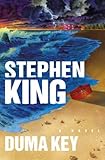 Duma Key by Stephen King
My review
rating: 4 of 5 stars
This may not have been Stephen King's best novel, but it's up there, and it's going to stick with me for a long time. Like many of King's recent works, the book is not so much terrifying as emotionally haunting; it is full of suspense and a heaping dose of the supernatural, but its power comes from its exploration of human grief and suffering.
Faithful readers will appreciate some of the nods King makes to his other books, though some are familiar to me from their film adaptations. (For example, there's a line that seems lifted almost straight from "Stand By Me" and there are refernces familar from "The Shawshank Redemption.") The evil China figurine Perse reminds me of the can toi from "The Dark Tower" series as well as "Desperation", but I'll need to spend some quality time on Wikipedia exploring those links.
Bottom line, King will fans will love this, but like Bag of Bones and Hearts in Atlantis, I'd recommend it as well to those who have never read him. He once again proves his chops as a writer of serious literature.
View all my reviews.
Labels: criticism, Stephen King
Tuesday, March 11, 2008
I just read "The Shining" (spoilers ahead), and it's one of those books, which I've discussed before, that I'm glad I read after seeing the film adaptation. I wouldn't have enjoyed Stanley Kubrick's movie version nearly as much had I read the book first.
Stephen King, you may know, was not too pleased with Kubrick's adaptation. For one, he thought Jack Nicholson's interpretation of the character of Jack Torrance left little doubt that he would go insane and try to murder his family. When we meet him, he seems halfway there already.
Indeed, Jack Torrance was a far more complex character in the novel, and the film by necessity dispensed with much of his backstory. Jack Torrance of the film was clearly ill-suited for domestic life, and barely cared to conceal it. The Torrance of the novel, however, was a loving father who wanted to be a good husband. Nonetheless, he was beset by demons that cost him his job, and it was out of desperation that he agreed to become the caretaker for the Overlook Hotel.
In the book, Jack Torrance struggled against insanity, but was overcome by the hotel's malignant power. This was a tragedy in the novel; in the film, it was the subject of black comedy. Torrance was merely a horror film monster that had to be evaded and destroyed. I do give the film credit, however, for providing a more chilling ending than the book. At the end of the novel, the hotel was destroyed, its evil laid to rest. But in the film, it lived to fight another day, and Jack Torrance had become part of its dark history.
Labels: "The Shining", film adaptations, Stephen King
Thursday, July 26, 2007
WARNING: HARRY POTTER SPOILERS AHEAD
I found myself discussing the final Harry Potter book this morning with my wife on my cell phone, after reading the last chapter on the bus this morning. She had finished the book two days ago and was itching to talk about the ending. I nearly had to pull an all-nighter to get as far as I did before heading off to work today.
I was happy with the book’s ending. It would have been a bold stroke to let Harry die, but I think J.K. Rowling stayed true to her character, and to the series’ own mythology, in the manner in which Harry manages to beat Voldemort and survive--as it turns out, to go on to live a comfortable bourgeoisie life with Ginny and their three wizard children. Yes, the “Nineteen Years Later” epilogue was a bit hokey, but it could have been worse—Harry and Malfoy could have ended up as golfing buddies.
The most moving part of the book came when Harry looked into the memories of the recently killed Snape. It was no surprise to learn that Snape had not betrayed Dumbledore after all—I suspect most readers believed all along that this would be the case. But I didn’t expect Snape to turn out to be the true tragic hero of the “Harry Potter” series, a man redeemed from evil by his unrequited love for Harry’s mother. The description of Snape’s childhood was heart-rending (it also softened our image of Harry’s Aunt Petunia; it was sad and ironic that Snape’s mistreatment of her as a child no doubt contributed to her abuse and neglect of Harry later on), and I was touched as well by his retrained affection for Dumbledore, who became his surrogate father.
As I drew nearer the end of “The Deathly Hallows”, I couldn’t help but think of some of the works of Stephen King, namely “It” and the novella “Low Men in Yellow Coats” from “Hearts in Atlantis.” In both stories, children are thrust into battle with the forces of evil, and gradually learn that the adults in their lives are flawed, often terribly so, and that many of the truths they’ve clung to turn out to be false. This is a recurring theme in much of King’s work, in which true horror lies not in the supernatural but in the hearts of men.
Similarly, Harry Potter must repeatedly confront the fact that his heroes are not the idealized figures he imagines them to be. His father was arrogant and had a streak of cruelty that, in his mistreatment of Snape and Wormtail, contributed to his own destruction. Sirius did not entirely escape the haughtiness that was his family’s hallmark. Even the sainted Dumbledore was once a power-hungry elitist with little time for those less talented than he. The reverse was also true—Harry misjudged the complexities of the human heart in assuming Snape to be evil, and one imagines that he would always regret never having the opportunity to become the brooding wizard’s friend.
These are, of course, important lessons for children to learn, but they are easy to forget as adults. We learn something new about the people in our lives everyday, and often we continue to learn about them even after they are gone. Love is the one constant, and like Harry and the Dark Lord, we too often underestimate its incredible power.
Labels: criticism, Harry Potter, Stephen King
Friday, July 06, 2007
With the final installment in the Harry Potter series about to hit bookstores, and in the wake of the controversial "The Sopranos" finale, I've been thinking a lot about what, if anything, the creators of a popular saga owes to their audience.
Last year, Stephen King brought to a close "The Dark Tower" saga--like Harry Potter, a seven-book series--and plenty of his readers felt let down by the ending. (To me, the ending was perfect, but the final two books didn't match up to the others, particularly the first four.) King, however, has always stressed that he goes where the story takes him, and the few books that he plotted out in advance are, to him, his worst. King brought this point home in "The Dark Tower" series by creating a fictional version of himself who, in the final two books, was manipulated and directed by the characters he had created. (A gambit that many readers didn't exactly appreciate.)
Of course, no one wants a writer or artist to pander to the audience. If David Chase had ended "The Sopranos" in a hail of bullets, or with Tony led away in handcuffs, a large contigent of the show's viewers--myself included--might have been disappointed. I liked the idea that Tony was caught in a purgatory of his own design, always having to keep an eye on the door.
Still, when an audience's vision of a story veers dramatically from the artist's, the results can be ugly--as demonstrated by fan reaction to the first two "Star Wars" prequels. It wasn't just the wooden acting and leaden dialogue that doomed those two films. As one critic put it, "The Phantom Menace" was like watching C-Span in outer space. Trade Federation? Taxation policies? That's not what "Star Wars" was about. Of course, if one watches these excised scenes from the original film, you'll realize that George Lucas probably stayed relatively true to his vision for the story. One of the reasons that "Revenge of the Sith" received a warmer reception than the first two prequels was that it portrayed many of the events that were referenced in the first three films, and had much less of the additional mythology that most fans could have cared less about.
Like Lucas, King and "Sopranos" creator David Chase, J.K. Rowling is bound to disappoint some fans, regardless of whether Harry Potter gets to ride his broom off onto the sunset--or whether he goes to that great Quidditch match in the sky.
Labels: "Star Wars", "The Dark Tower", "The Sopranos", criticism, Harry Potter, Stephen King
Sunday, April 29, 2007
Copeland points us to a fantastic resource--155 Classic Short Stories, all online. I have to admit that of the few stories on the list that I've read, most were assigned to me when I was in school. Stephen King, who has written some great short stories and novellas, has lamented the decline of the genre as a form as popular literature. Even until the mid-1990s, Esquire and GQ used to regularly publish short fiction, and a lot of it was damn good. I have to confess that I rarely read the fiction published in the New Yorker, and I think I'm going to resolve to change that.
Labels: Dave Copeland, short stories, Stephen King